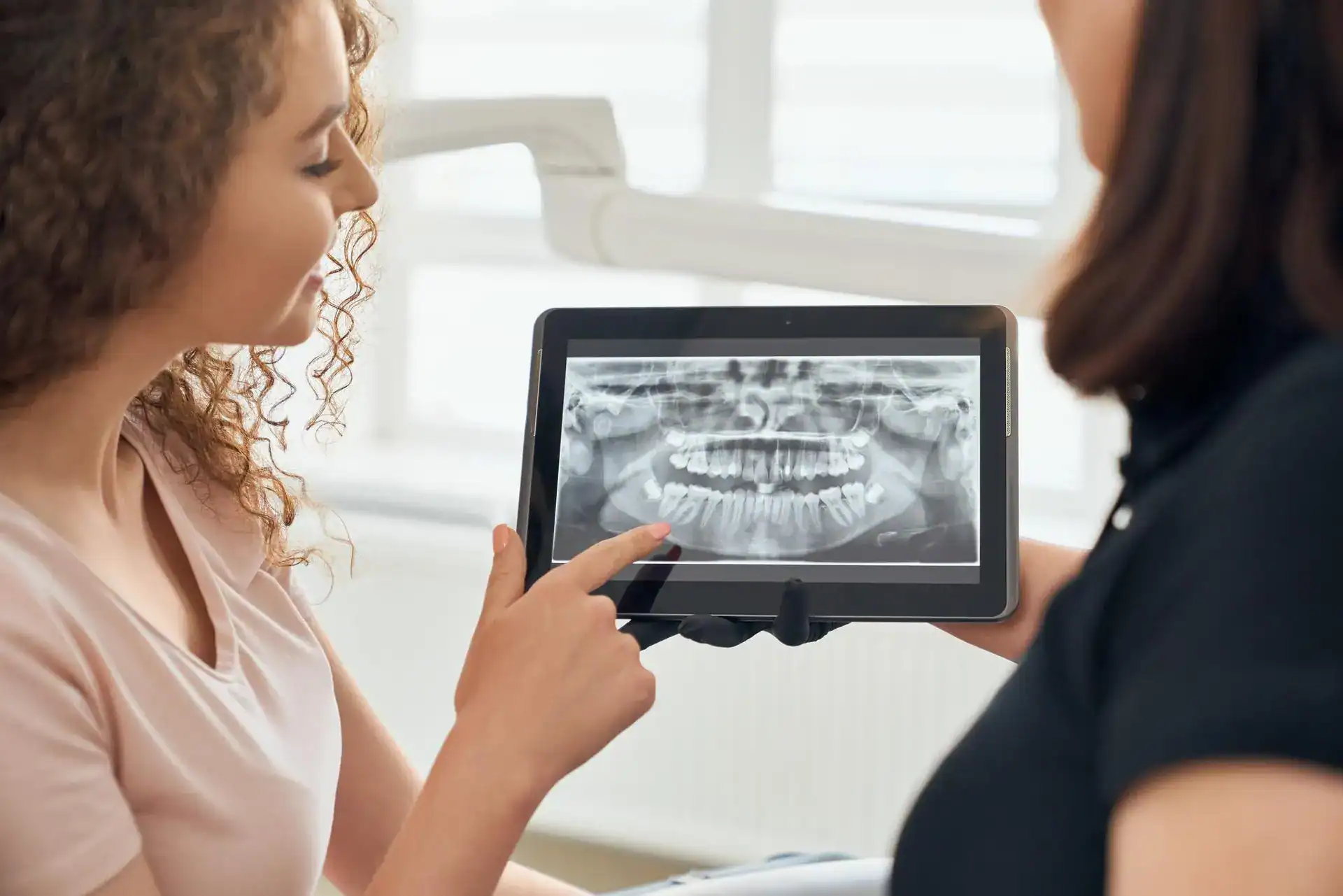
When you sit in the dental chair, you want to know exactly what is happening beneath the surface of your teeth without unnecessary delays or worries. At our dental practice in Reading, we have replaced slow, chemical-heavy traditional film with modern digital dental x-rays. This transition means we can capture highly detailed diagnostic imaging in a fraction of a second. By using a sensitive intraoral sensor instead of rigid film packets, we can reduce your radiation dose by up to 80 percent. It is a safer, faster approach that respects both your health and your busy schedule.
Many dental issues develop in places the naked eye simply cannot reach. A visual exam might show healthy enamel, but a digital bitewing radiograph can reveal hidden interproximal decay forming between tightly spaced teeth. By viewing these high-resolution files on our image processing software, we can spot early enamel demineralization before it turns into a painful cavity. This early bone loss detection is crucial for managing gum disease before it compromises your teeth. We do not guess about your health; we use clear, objective data to plan your care.
If you have struggled with a strong gag reflex during older dental exams, you will appreciate how much easier this process has become. We use a slim, contoured sensor plate that fits comfortably inside your mouth without scraping your gums. There is no waiting around for films to develop in a darkroom. The image appears on our screen almost instantly. This allows us to walk you through the findings in real time, showing you exactly what we see so you can make informed decisions about your treatment.
When you sit in the chair, you want to know exactly what is happening beneath the surface of your teeth without unnecessary waiting or worry. Traditional film radiographs required chemical processing that took several minutes, keeping you in suspense while we waited for the physical film to develop. With our digital X-ray system, we capture high-resolution views of your teeth and jaw instantly. The thin, rounded intraoral sensor sits comfortably in your mouth, completely eliminating the sharp edges of old-fashioned plastic film packets that used to trigger your gag reflex.
Safety is an understandable concern for many families, especially when it comes to children’s check-ups or routine screenings. Our digital system reduces your radiation dose by up to 80% compared to legacy film. We still place a protective lead apron and thyroid collar as a standard precaution, but the actual exposure lasts only a fraction of a second. The resulting periapical image or bitewing radiograph appears on screen immediately, allowing our team at our dental practice in Reading to walk you through your images in real time and point out early signs of enamel demineralization or hidden interproximal decay before they turn into painful, costly emergencies.
The clarity of digital files is a significant leap forward for preventive care. Using specialized image processing software, we can zoom in, adjust contrast, and track subtle changes over time — crucial for catching early bone loss or decay in its earliest stages. This precision means we only treat what is strictly necessary, keeping your treatment plan highly targeted and minimally invasive.
Minimal Radiation — Digital sensors cut exposure by up to 80% compared to traditional dental film.
Instant Results — High-resolution images appear on screen in seconds, eliminating long waits for chemical development.
Enhanced Comfort — Soft, rounded sensor plates replace the sharp, rigid plastic frames of the past.
Earlier Detection — Advanced contrast tools reveal tiny pockets of interproximal decay and early enamel demineralization.
Eco-Friendly Process — By eliminating liquid chemical developers and lead foils, we keep our Reading community cleaner.
Many dental conditions develop quietly beneath the surface of your enamel, completely out of sight during a standard visual examination. Without precise diagnostic imaging, early signs of enamel demineralization or tiny pockets of interproximal decay between tightly spaced teeth can easily go unnoticed until they reach the nerve. By the time you actually feel a toothache, a simple cavity has often progressed into a deep infection requiring a root canal or extraction. Using a modern intraoral sensor allows us to spot these microscopic changes early, saving you from invasive treatments and unexpected emergency appointments.
It is not just about cavities, either. Assessing the health of your jawbone is a critical part of preventive care. Advanced bone loss detection is virtually impossible without a periapical image or a bitewing radiograph to reveal the true height of the bone surrounding your roots. For patients visiting our practice in Reading, we prioritize safety by reducing the radiation dose to the absolute minimum. We use a protective lead apron and thyroid collar as standard practice, even though the digital sensor plate requires only a fraction of the exposure of old-fashioned film. This safety-first approach ensures we gather the vital data we need to protect your gums and bone without unnecessary risk.
We discuss your needs and examine your oral health.
We evaluate your smile using modern diagnostic tools.
We create a care plan tailored to your goals.
We provide comfortable and efficient dental treatment.
We share simple instructions for proper healing and care.

Routine visits help keep your smile healthy long-term.

Waiting until a tooth hurts before booking a diagnostic scan often means missing the early windows for simple, conservative treatments. Many serious dental issues develop silently beneath the gumline or deep between tight teeth where a standard visual inspection cannot reach. Without precise diagnostic imaging, early signs of enamel demineralization and microscopic interproximal decay remain completely invisible. By the time you feel physical discomfort, the underlying issue has likely progressed to a point requiring more invasive and expensive restorative work. Relying on advanced imaging ensures these hidden threats are identified long before they compromise your oral health or disrupt your daily life.
At Willow Dental, we believe diagnostic imaging should be a seamless, stress-free part of your routine care. Unlike large corporate dental chains where you might see a different face at every visit, our independent, family-friendly Reading dental practice prioritizes continuity of care. Every member of our clinical team holds active American Dental Association (ADA) registration and strictly adheres to the Massachusetts radiation safety standards, ensuring your safety is never compromised.
We understand that some patients dread dental imaging due to past experiences with uncomfortable film packets or a sensitive gag reflex. Our team uses slim, rounded intraoral sensors and advanced image processing software that capture highly detailed bitewing and periapical views in seconds, minimising physical discomfort. We also make the administrative side simple; if you are joining us from another practice, we easily coordinate the transfer of your existing diagnostic records so you do not have to repeat unnecessary scans.
As a Massachusetts Department of Public Health regulated practice, we maintain rigorous quality controls, including designated Radiation Protection Supervisors and up-to-date state radiation safety protocols compliance. We never recommend imaging unless there is a clear clinical justification, and we always walk you through your panoramic or bitewing scans on screen so you understand exactly what we see. At Willow Dental, you get clear, honest guidance without any pressure or unexpected diagnostic fees.



Parents in Reading often ask us about safety. When we take Digital Dental X-Rays at our practice, we use an ultra-low radiation dose that is up to 90% lower than old-fashioned film. For children, we adjust the exposure settings to the absolute minimum required. We also provide a protective lead apron and a thyroid collar to shield vulnerable tissues. We only prescribe diagnostic imaging when there is a clear clinical need. If you are pregnant, we generally delay routine scans as a precaution, though emergency imaging remains safe with proper shielding.
There is no single rule for everyone. If you have a history of frequent cavities or enamel demineralization, we might recommend Digital Dental X-Rays, specifically a bitewing radiograph, every six to twelve months to catch interproximal decay early. For patients in Reading with excellent oral health and minimal risk, having them every two years is often plenty. We do not believe in over-prescribing scans. Our clinical decisions are guided by the Massachusetts Department of Public Health standards. We evaluate your specific risk factors, like dry mouth or existing large fillings, rather than running scans automatically at every check-up.
They serve completely different diagnostic purposes. When we perform Digital Dental X-Rays in Reading, a bitewing radiograph focuses closely on the crowns of your back teeth. It is our primary tool for bone loss detection and spotting hidden interproximal decay between tight teeth. In contrast, a panoramic X-ray loops around your entire head. This provides a broad, single image of your jawbone, sinuses, and wisdom teeth. We use the panoramic view to plan extractions or check your jaw alignment. For highly detailed 3D planning, such as placing dental implants, we might instead recommend a specialized digital panoramic scan.
Under basic insurance coverage, necessary diagnostic imaging taken during a routine check-up is fully covered within that single standard fee. For private patients in Reading, the cost of Digital Dental X-Rays depends on the specific type of image required. A standard intraoral sensor plate scan or a periapical image is relatively inexpensive, whereas a comprehensive digital panoramic scan carries a higher fee due to the complex image processing software and specialist reporting time. Many private dental plans and corporate health cash-back schemes reimburse these diagnostic costs. We always provide a clear, written estimate before taking any advanced scans.
It is a common worry, but the explanation is simple. While the radiation dose for a single set of Digital Dental X-Rays is incredibly small for you, our clinical team takes hundreds of these scans every week. If we stood next to the machine every time, our cumulative exposure over a year would be unnecessarily high. By stepping behind a protective screen or leaving the room for a split second, we eliminate this occupational risk. Our practice in Reading operates in strict compliance with the ionizing radiation Regulations 2017 (state radiation safety protocols), ensuring a safe environment for both our patients and our staff.
Trustindex verifies that the original source of the review is Google.
Great office! Great staff! Always a pleasure to go to the office.Posted on Google
 Jane ReynoldsAn exceptionally good dental practice in all ways. You will be very happy with your visits there.Posted on Google
 Tobey Shepherd Linden Tree InnThey are very friendly and do great job!Even my little kids like to see the dentists now after few times experence with them!Posted on Google
 Jenny HeTop notch service by a professional staff utilizing state of the art equipment. Courteous, caring and safe environment. Highly recommend!Posted on Google
 Mark AndersonI felt completely secure with all the extra precautions the office has put in place for the COVID-19 regulations. Paula did a great job with my cleaning. Everyone was friendly and accommodating. Thanks for another great check up!!Posted on Google
 Tobey ShepherdBrought my father in law to Dr Vouras yesterday. The entire process was seem less. From scheduling to treatment from Dr Vouras and her staff. Exceptional and professional. They accommodated our needs and requests. Did I mention he's 103 and his appointment could not have gone any better. Thanks is an understatement.Posted on Google
 Pat IapiccaWonderful team! Pleasant and gentle approach. Thanks!Posted on Google
 Donis PerkinsDr. Vouras is amazing. Very personable. I greatly enjoyed my experience with her as a new patient and will be an ongoing one.Posted on Google
 Toni DeRosa
If it has been more than a year since your last set of bitewing radiographs, or if you are experiencing unexplained sensitivity, it is time to get a clear picture of your oral health. Our team at Willow Dental uses comfortable intraoral sensors to capture high-resolution diagnostic imaging in seconds, helping us catch enamel demineralization before it turns into a painful cavity.
You do not have to guess about what is happening under your gums. Contact our dental practice in Reading today to schedule your comprehensive exam and experience a gentler, faster approach to preventive dental care.